
IONIQ 20: TECHNOLOGY
A high voltage loaded sharp end is applied next to an earth connected base and in between lays the plastic part we test. Should a hole exist in the part, ions will start moving from the earth to the sharp end. This will result in a loss of power and be translated into a leak.
While this method does not quantify the leak rate in terms of cc/min for example, it is the fastest ever invented to detect a leak in a go / no go process. We have achieved cycle times of less than 7/10 of a second.
Leak Ranges: Depends on the size of the hole and the material of the part
Accuracy: Depends on the size of the hole and the material of the part
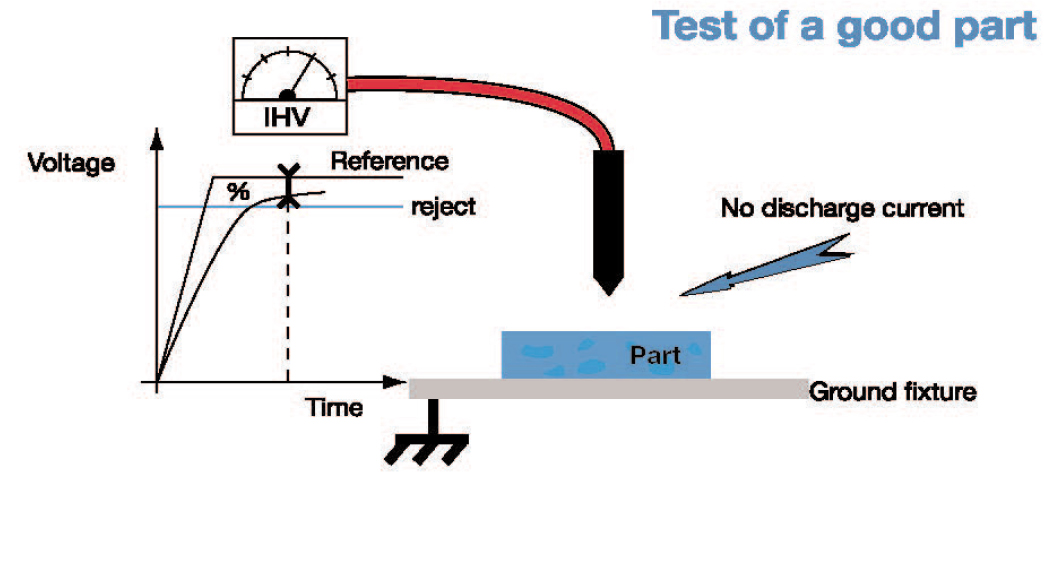
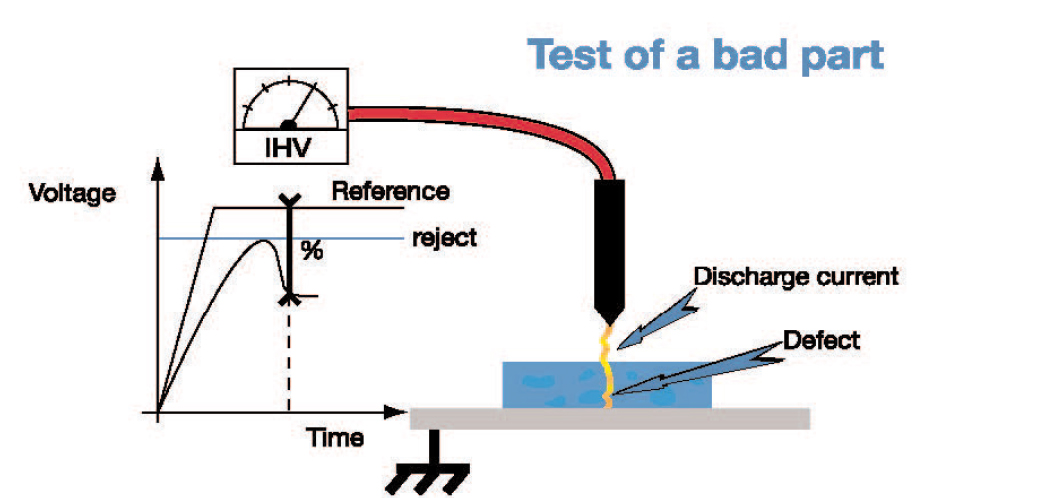
- The IONIQ measures the current flowing between a patented charged probe and a ground plate placed under the part to be tested.
- The IONIQ uses the % of the nominal voltage (which reflects the discharge current), measured on the part as PASS/FAIL level.
- In a PASS situation (fig 1) : No hole, no weak part, the IONIQ measures a high %. The measured voltage and the nominal voltage are virtually equal. The result is above the reject level, the part has passed the test
- In a FAIL situation (fig 2) : The IONIQ measures a low %. The measured voltage is significantly below the nominal voltage. The result is below the reject level, the part has failed the test.
- Test limitations: short probe-part-plate distance, electrical insulation from environment.